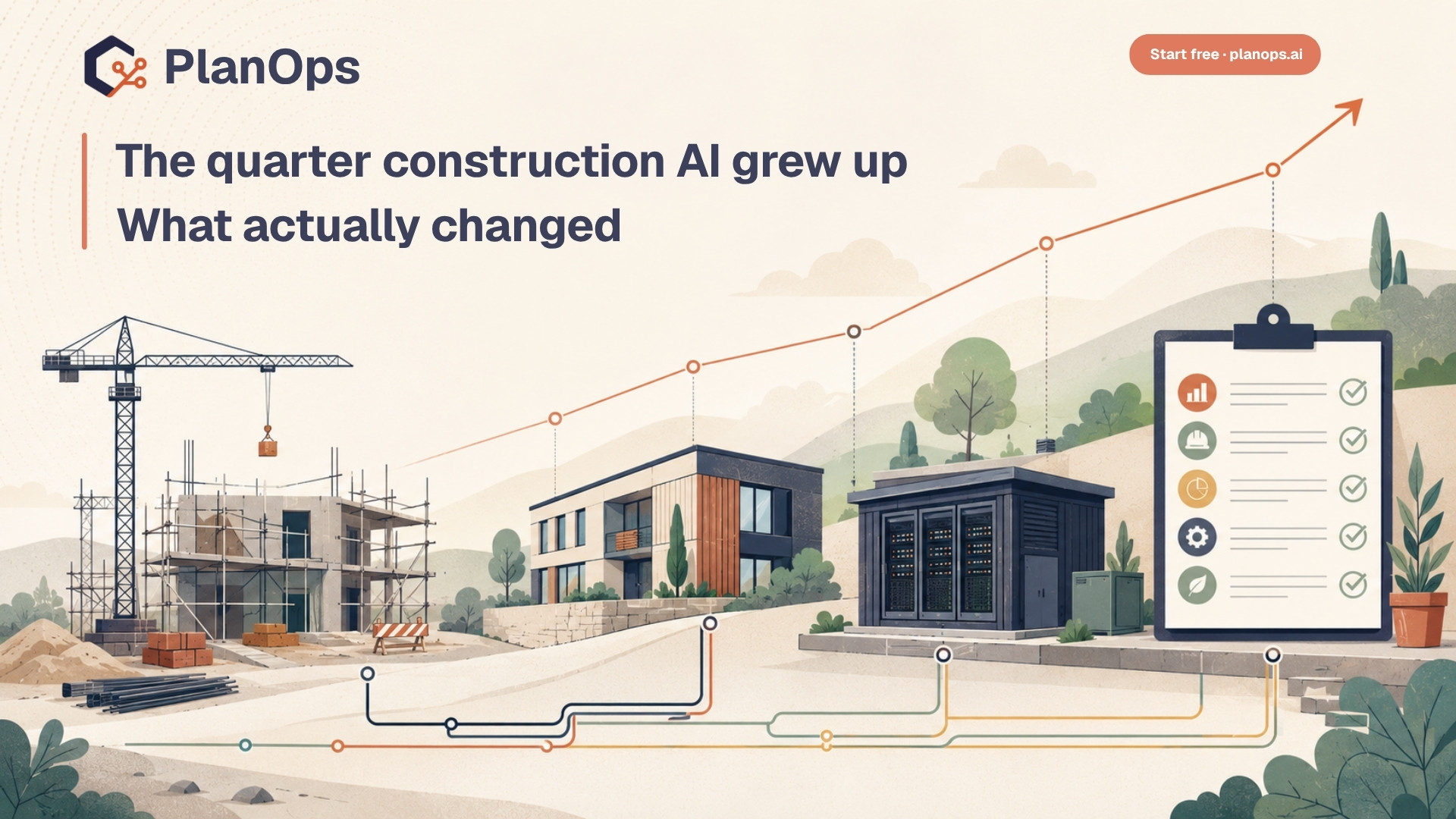
We've been writing the Construction AI Brief every working day for just over three months now. That's around 65 issues. So this time, instead of the usual daily snapshot, it's worth stepping back and asking what the quarter actually told us - about UK construction, and about the wider AI world it sits inside.
The short version? The conversation grew up. In March we were still asking whether AI was useful. By June we were asking who's accountable when it gets something wrong, who owns the data it's trained on, and whether you can even keep running the model you've built your workflow around. That shift - from capability to consequence - is the real story of the quarter.
Here's how it played out.
UK construction: from talk to workload relief to measurable ROI
The most striking thing across the quarter is that the adoption numbers stopped being aspirational. The Association for Project Management found 75% of construction project professionals now using AI - up from 15% two years ago, with 91% planning to invest more this year. Houzz's first UK State of AI report put early adopters at roughly three hours saved a week and around £23k a year per practitioner. The contractor adoption figure more than doubled in a year. These aren't survey-deck fantasies any more. They're people doing the work and counting the hours back.
But, and this matters, the gains kept landing in the same unglamorous places. Estimating and takeoff was the use case that quietly paid back for SMEs and mid-tier firms - Togal reporting 50-80% takeoff-time cuts, Kreo claiming 85-92% accuracy on simple geometry, steel takeoff becoming a clear worked example rather than a pitch. Building Safety compliance was the other one: Truelens and OptimaBI compressing a 10-day Gateway 2 check to about an hour, a 73% cut, tested and adopted by real consultancies. Scan-to-BIM in under 30 minutes from NavLive. Reality capture with hard hours-saved numbers behind it at Sir Robert McAlpine and Vinci. FYLD's risk assessment rolled out to 2,500-plus Amey field workers. None of it is futuristic. All of it is repetitive, document-heavy, error-prone work that AI is genuinely good at.
The second clear theme: the bottleneck moved. Early in the quarter the hard part was generating things. By the end it was reviewing, deploying and orchestrating them - and fixing the disconnect between the office and the site. Construction Management argued the gains will stall until firms sort that out, and the data-quality warning kept recurring (76% of industrial AI projects fail because the data isn't ready). The lesson is consistent with everything we already know in this industry. The technology was rarely the blocker. The workflow was. PlanOps has workflows 🙂
Third, AI stopped being a bolt-on and became plumbing. Claude now runs inside Bluebeam Revu and Max via MCP. Procore relaunched its Common Data Environment with agentic coworkers embedded and chose the UK and Ireland to go first. Autodesk turned Forma Assistant into an orchestration layer with public Revit and Fusion MCPs. By June, MCP had effectively become the integration standard for AEC software - which is a big deal, because it means the AI is arriving inside the tools your teams already open every morning, not as another login.
And fourth, the contractors started building their own. Skanska's "Expert Sidekicks" train agents on how its experienced safety leaders actually reasoned, not just on the rules. Rodic unveiled an air-gapped, sovereign AI ecosystem with full data control retained by the customer. Turner & Townsend put serious leadership behind its AI push. The maturity curve is visible: trial, then embedded tool, then bespoke agent built on your own expertise.
Data centres became their own construction story
If one theme earned its own category this quarter, it's this. AI data centre construction went from a tech talking point to a live UK delivery market - and a politically charged one. A £10bn campus approved in North Lincolnshire. A £10bn campus in Aberdeen putting grid access back at the centre of delivery. SEGRO and Pure DC's £1bn hyperscale scheme in west London. A 147MW Slough data centre pushed through on a recovered appeal across part-greenfield land, the housing secretary judging the benefits sufficient to outweigh the harms. Even floating data centres, with Samsung Heavy signing designs at Posidonia.
But the backlash built just as fast. Housebuilders warned that data centres are pulling specialist MEP trades and grid capacity away from homes - and a16z's $50m into Endra's MEP-design AI lands exactly on that bottleneck. Job claims got labelled "ludicrously inflated". Public First's polling showed more Britons support data centres than oppose them, but opposition jumps to 25% when one's proposed within three miles. The government named AI infrastructure a national security procurement priority, updated planning guidance to factor AI demand into local plans, and by mid-June had RIBA running a design competition to make these sheds something communities tolerate. The constraint underneath all of it isn't chips - it's power, grid and planning. The US showed us where that leads, with transformer waits hitting five years and nearly half of planned builds delayed.
Policy and governance closed in
The regulatory drumbeat got louder all quarter, and it's worth being honest that this is now a board-level set of questions, not an IT one.
The EU AI Act's high-risk obligations become applicable on 2 August 2026, and they reach UK firms whose AI outputs touch the EU. That deadline went from "in view" in May to "binding date" by June. The government published its Copyright and AI report and held its position - which means IP ownership for AI-generated design content is still unresolved. The Treasury and DSIT launched an AI Economics Institute under Nobel laureate Simon Johnson to measure AI's real effect on productivity and jobs, with construction squarely in frame. On Building Safety, the Gateway 2 logjam genuinely cleared - approval times down from a 48-week peak to 13-14 weeks - but the bottleneck simply moved forward to Gateway 3.
Two governance signals deserve flagging because they hit you directly. First, professional indemnity insurers (Berkley among them) started writing absolute AI exclusions into cover, naming generative tools specifically. If you use AI on chargeable work, that's a conversation to have before your next renewal. Second, by June the platforms began openly fighting over data - Procore cut a rival agent off at its API, and vendors are now hoarding project data to train their own agents. The data clause in your software contract just became something you actually need to read.
The wider AI space: faster, cheaper, and suddenly about control
The model cadence was relentless. Anthropic shipped Opus 4.8 with native multi-agent workflows, then the Fable 5 / Mythos tier; Google ran I/O with Gemini Omni, Flash and Spark; OpenAI answered with Daybreak; and open weights kept closing the gap - MiniMax M3 at a tenth of frontier pricing, Gemma 4 12B running on a 16GB laptop. The direction of travel on cost is firmly down. A Flash-tier model now beats last year's Pro at 40% less.
But the more interesting shift was in what everyone was building for. The first half of the quarter was about capability - longer context, multi-agent runs, coding agents. The second half was about control: long-running-agent blueprints, supervision dashboards like Claude's Agent View, self-hosted sandboxes and containment, frontier AI becoming an enterprise security category in its own right (OpenAI's Daybreak versus Anthropic's Mythos/Glasswing). And a genuinely sobering reminder of dependency - when the US ordered Anthropic to cut its top models off from foreign nationals, Anthropic shut them down worldwide rather than block its own staff. If your workflow depends on a single frontier model, that's a risk worth naming out loud. It's also worth keeping perspective: every major model still scored 0% on the new ARC-AGI 3 reasoning benchmark, where untrained humans hit 100%. The ceiling is real.
What it adds up to - and what to watch next quarter
Step back, and the quarter has a clear shape. Hype gave way to practical. Practical became embedded. Embedded is now being governed. The tone at Digital Construction Week and UK Construction Week was noticeably calmer and more grown-up than a year ago - less robot showpiece, more succession, evidence and accountability. That's a healthy sign for an industry that's been burned by technology promises before.
For the next quarter, here's what we'll be watching:
- The 2 August EU AI Act deadline - the first hard compliance date that reaches UK firms. If your AI outputs touch the EU, this is the one.
- Gateway 3 as the new Building Safety bottleneck now that Gateway 2 has eased.
- Data ownership and platform contracts - who owns what your software vendor's agents learn from your projects.
- The data-centre-versus-housing trade-off - trades, grid and planning capacity, and whether the politics settle.
- Frontier-model dependency - sovereignty, data residency and having a fallback if your model gets pulled.
- Insurance exclusions - check your PI cover before you renew.
Three months in, the Brief's job hasn't changed: tell you what moved, why it matters, and what to ignore. But the centre of gravity has. We're past wondering whether AI belongs on construction projects. The questions now are about evidence, accountability and control - which, for an industry that lives and dies on exactly those three things, is precisely where the conversation should be.