A decade ago, opening a bank account meant a branch visit, a form, and a wait. Then Monzo and Starling turned up: an app, an account in minutes, fees you could actually find published, and the ability to leave whenever you liked. The high street banks weren't bad at banking. They were built for a world where the customer had no realistic alternative, and their products showed it.
Something similar is now happening in construction software, and it needs a name. I've started calling it challenger construction software: broad, AI-first platforms taking on the big incumbent systems. This article sets out what the term means, why the category exists at all, and how to tell a challenger from something that just has "AI" in the brochure.
One thing to say plainly at the start: PlanOps is a challenger, so we have an interest in this category existing. We've tried to define it in a way that can be applied to us as strictly as to anyone else, and you should hold us to that.
The maths
Construction management software has been dominated for years by a handful of large platforms. Procore, Autodesk, Bentley and their peers built serious products, and plenty of major contractors run on them successfully. This isn't an argument that they're bad software. It's an argument that their commercial model was shaped by the economics of a different era, and those economics no longer serve the buyer.
Consider what it took to build a broad construction platform in 2012. Hundreds of engineers, years of development, and an enormous amount of capital. Once you've spent that, the maths pushes you in a predictable direction. You price per seat, because seats are how you recover the investment, or you price using an opaque turnover percentage. You sell through a sales team, because six-figure annual contracts don't sell themselves, and that means demos, procurement cycles and negotiated pricing rather than a published price list. You sign multi-year deals, because the cost of acquiring each customer is so high that you need them locked in to make the numbers work. And once a contractor's project history lives inside your system, leaving becomes expensive enough that renewal is close to automatic.
That's what the cost of building software used to demand. But look at it from the buyer's side: you can't find the price without booking a call, you can't start without an implementation project, you pay for every person who needs to so much as view a document, and by year three the question "should we stay?" has quietly become "could we even leave?"
If that pattern sounds familiar from banking before 2015, it should. High acquisition costs, opaque pricing and switching friction produce the same customer experience in any industry.
What changed
The reason construction software challengers exist now, and didn't five years ago, is that AI collapsed the cost of building software.
A small team with modern AI tooling can now build, in months, the breadth of product that used to take an incumbent's whole engineering organisation years. I can be specific about that, because we're the worked example: PlanOps is a company in single figures - a handful of engineers, a couple on marketing and comms, and a couple running the business. The product updates are the record of what that team ships and how often: drawing revision comparison, temporary works to BS 5975, permits raised from a QR code, risk registers, document control, SharePoint and Viewpoint connections. In 2020 that list was a floor of engineers and a five-year roadmap.
That changes the maths from the ground up. When building is cheap, you don't need six-figure contracts to recover your costs, so you can publish your pricing. You don't need a sales team to justify each deal, so buyers can start on their own. You don't need lock-in to make the customer maths work, so you can let the data walk out of the door and instead win the renewal on the benefit the software provides.
And the same shift changed what the software can do. These platforms don't just use AI to build faster; AI sits inside the product doing actual work. Writing the report, checking the pack, comparing the revisions, chasing the missing documents. The category exists because both changes landed at once: cheaper to build, and fundamentally more capable once built.
The five tests
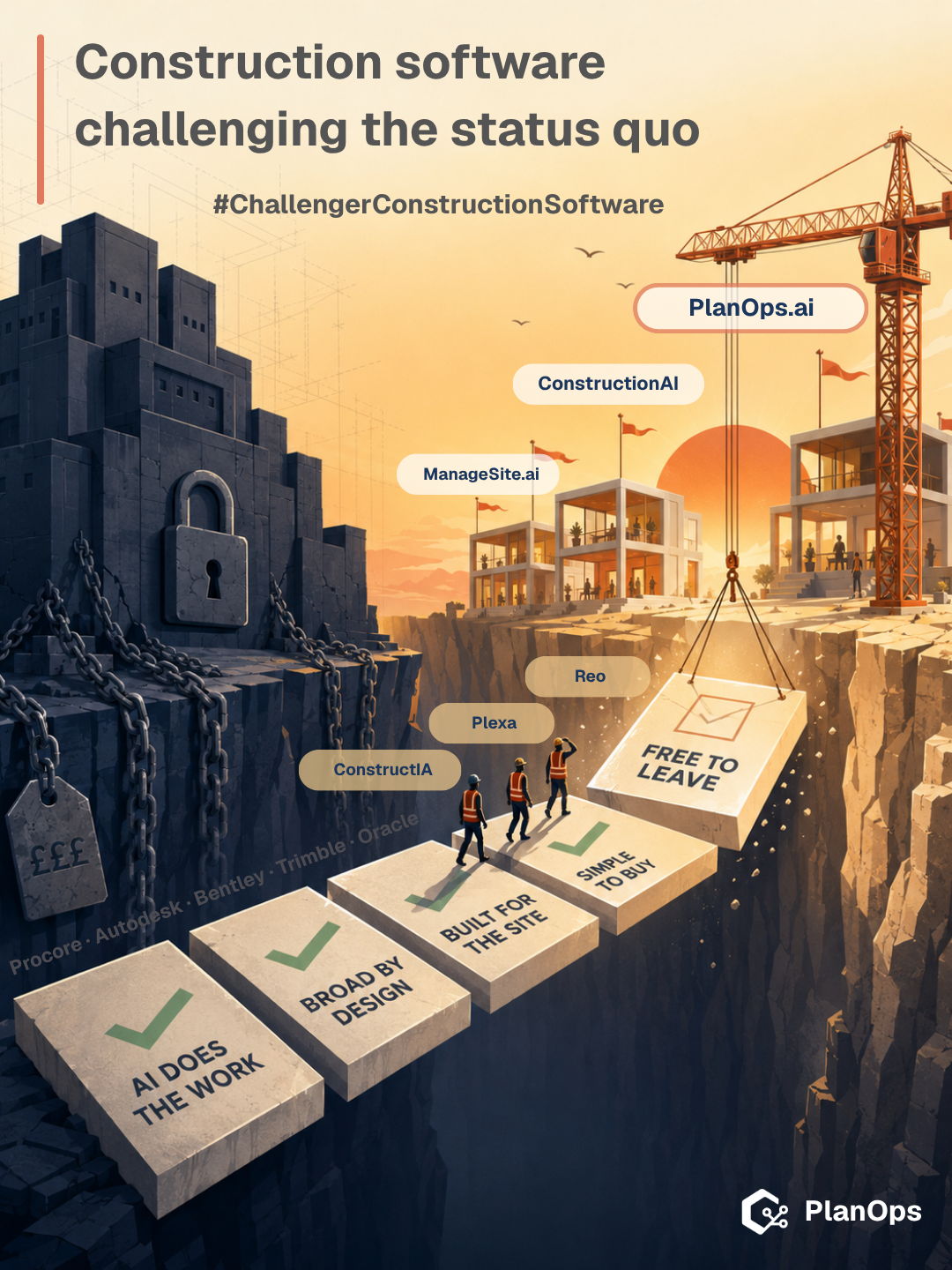
A category survives if it's precise, so here is the definition we use. A challenger construction software product meets all five tests.
1. AI does the work. AI sits at the core of the product carrying real workload: reporting, checking, comparing, chasing. Not just a chatbot bolted onto a legacy platform. If you switched the AI off and the product still basically worked, it fails this test. To check it: run your own documents through it and ask for a finished thing - a report, a checked pack, a comparison. If everything that comes out still needs a person to write it, the AI isn't carrying the work.
2. Broad by design. It covers a wide slice of how a project actually runs, not a single task. This is the test that AI made possible: a small team can now ship the breadth that used to take an incumbent's whole product suite, so narrowness is now a choice, not a constraint. To check it: count the products you'd still need afterwards. If one login covers safety, quality, document control and commercial, it's broad. If it does one of them beautifully, it's a point solution.
3. Built for the site. Usable by the person doing the paperwork, the site team, not just head office. If it needs a training course before the site team can file an inspection, it fails - it should be useful before anyone learns the software. To check it: put it in front of a site manager for an afternoon, on a live project, with nobody sitting next to them, and see whether anything usable comes out.
4. Simple to buy. Published pricing and a simple direct sign-up to get started. If the price is "book a demo", it fails. This one test alone eliminates most of the market. To check it: open the pricing page.
5. Free to leave. No multi-year lock-in, and your data walks out with you in a usable form. A challenger wins the renewal by providing measurable benefits and transparent ROI, not by being difficult to exit. To check it: open the terms of use and search for "export".
Notice which of those you can do this afternoon without speaking to anyone. Tests four and five are a pricing page and a terms page: they either say it or they don't. Tests one to three need the product in your hands on a real project. Which is why test four carries more weight than it looks like it does - a free trial you can start this week is the thing that lets a buyer check the other three at all.
Or in a single sentence: could you start this week without a purchase order, could the site team use it that same week without a training course, does the AI carry real work across more than one part of the job, and could you leave next month without a legal letter? If the answer to all of that is yes, you're probably looking at a challenger.
What doesn't count, and what isn't a criterion
Two exclusions keep the definition sharp.
The incumbents don't qualify, whatever AI features they announce. An AI assistant added to a per-seat, sales-led, locked-in platform changes the feature list without changing the deal. The tests are about the whole product and the whole relationship, and a bolted-on copilot passes neither test one nor tests four and five.
Narrow AI point solutions don't qualify either, however good they are. A tool that only does drawing comparison, or only progress capture, or only take-off, can be excellent, and several are. But a single solution is just one aspect of how a construction project runs, it's not a platform for running it, and the category is defined by breadth.
Just as important is what we deliberately left out: funding structure and founder story are not criteria. It's tempting to define challengers by who built them or how they're financed, and early drafts of this definition did exactly that. I dropped it. A bootstrapped company can build a locked-in, sales-led product, and a VC-funded one can build something open with instant access. Judge the product, not the funding model.
The objection that cuts the other way
The obvious reply to all of this is: fine, but you're small. What happens to my project record if you're not here in three years?
It's a fair question, and it's where the banking comparison stops being flattering. The challenger banks had a backstop this industry doesn't: deposits were protected by the same statutory scheme whoever was holding them, so going with the new option never put the money at extra risk. Construction software has no equivalent. Nothing outside the contract guarantees your project record.
So the guarantee has to live in the product and the terms, which is test five read in the other direction. Lock-in and company risk are the same problem from opposite ends: both are questions about whether you can get your project out. A platform you can leave at will is also a platform whose failure you would survive. Ask it in that order. Can I export everything, today, without asking permission? Is what comes out readable in something that isn't your software? What notice do I get if you stop trading, and how long do I have to get the data out after that? Ours are written into the terms: export from inside the product at any time, 90 days' notice where practicable if we ever stop offering the platform, and a 90-day window after any termination in which we still hold your data and you can pull it out. The point isn't that those numbers are generous. It's that they're published, so you can hold us to them, and you should ask the same question of anyone else in this category.
It's also worth saying where the incumbent genuinely wins. If you're running a portfolio across dozens of projects, with integrations wired into finance, and a procurement framework that already lists them, the incumbent deal is a rational choice, and the size of the company is part of what you're buying. The challenger question for that reader isn't "replace everything". It's whether one project could run alongside, this quarter, at a price you can find on a web page.
Who's in
We've applied the tests ourselves, against public evidence: published pricing pages, terms of use, data export rights. This is a judgement as of the date on this article, and it will date - we're not publishing a running league table, and you shouldn't treat it as one. Applied strictly, three platforms pass all five tests today: PlanOps, Construction AI and ManageSite.ai. That's not a long list, and that's fine. Challenger banking also started with two or three names.
A handful of others sit just outside. Platforms like Reo and Plexa are broad, site-native and transparent on price, but currently fall short on one test, usually a demo-gated start or data export that we couldn't confirm from public pages. On that last point it's worth being fair: not publishing your exit terms isn't the same as locking customers in, and some of these companies almost certainly do let customers leave with all their data; they just don't say so anywhere that I could find. The test works on published evidence because that's all a buyer has. If that's the only test a platform is missing, it's fixed by a paragraph on a pricing page, and we'd genuinely like to see more companies in this category.
It's worth being clear that we want the other challengers to do well, and we'll say so when they do. A category with one company in it isn't a category, it's a marketing slogan. The comparison a buyer should be making isn't PlanOps against Construction AI or ManageSite.ai; it's the challenger deal against the incumbent deal. Published pricing against "book a demo". Start this week against some undefined point in the future. Free to leave against year three of a five-year contract. Every company that passes the five tests makes that comparison easier for buyers to see, whoever they end up choosing.
We expect the list to grow, and we'd rather it grew than stay comfortable. We'll keep saying where it stands as things change: when a new platform passes all five tests, we'll say so, and when a company on this list starts failing them, per-seat creep, a lock-in clause, a quiet retreat from published pricing, we'll say that too. The same applies to us. And if you're one of the companies named here and we've read your published pages wrong, or you've since published the thing we couldn't find, tell us and we'll correct it in the next one of these.
Why the name matters
Buyers evaluating construction software today inherit a set of assumptions from the incumbent era: that implementation takes months, that pricing is negotiated, that switching is a once-a-decade trauma and multi-year process, that the site team will need training before anything useful happens. Those assumptions make sense inside the incumbent model. Applied to a challenger, they're simply wrong, and they cause buyers to ask the wrong questions, run eighteen-month procurement processes for products that could have been tried in an afternoon, and discount small vendors for not looking like Procore.
Naming the category gives buyers a shortcut: these products play by different rules, so evaluate them by different rules. Try it, don't tender it, find out if it really works for you running alongside a real project. Check the price list rather than requesting a quote. Ask what happens to your data when you leave, and expect a plain answer.
Challenger banks needed the same shortcut. "It's a real bank, with the same protections, just built differently" was the phrase that let millions of people try one. "It's real construction software, broad and dependable, just built differently" is the sentence this category needs.
The test we can't avoid setting for ourselves
This definition cuts both ways. PlanOps publishes its pricing, priced plans from £100 a month, on a page you can read without booking a call, and you can start on your own today; if that ever changes, we fail test four and we'd deserve to be called on it. Our exit and export terms are published too, and our customers' data comes out in a usable form; if leaving PlanOps ever needs a legal approach, we fail test five. The definition is only worth anything if it stays harder to pass than to claim.
So that's the invitation. If you're evaluating construction software, incumbent, challenger or anything in between, apply the five tests and see what survives. And if you find a platform that passes all five that we haven't named, tell us. The category getting bigger is the point.