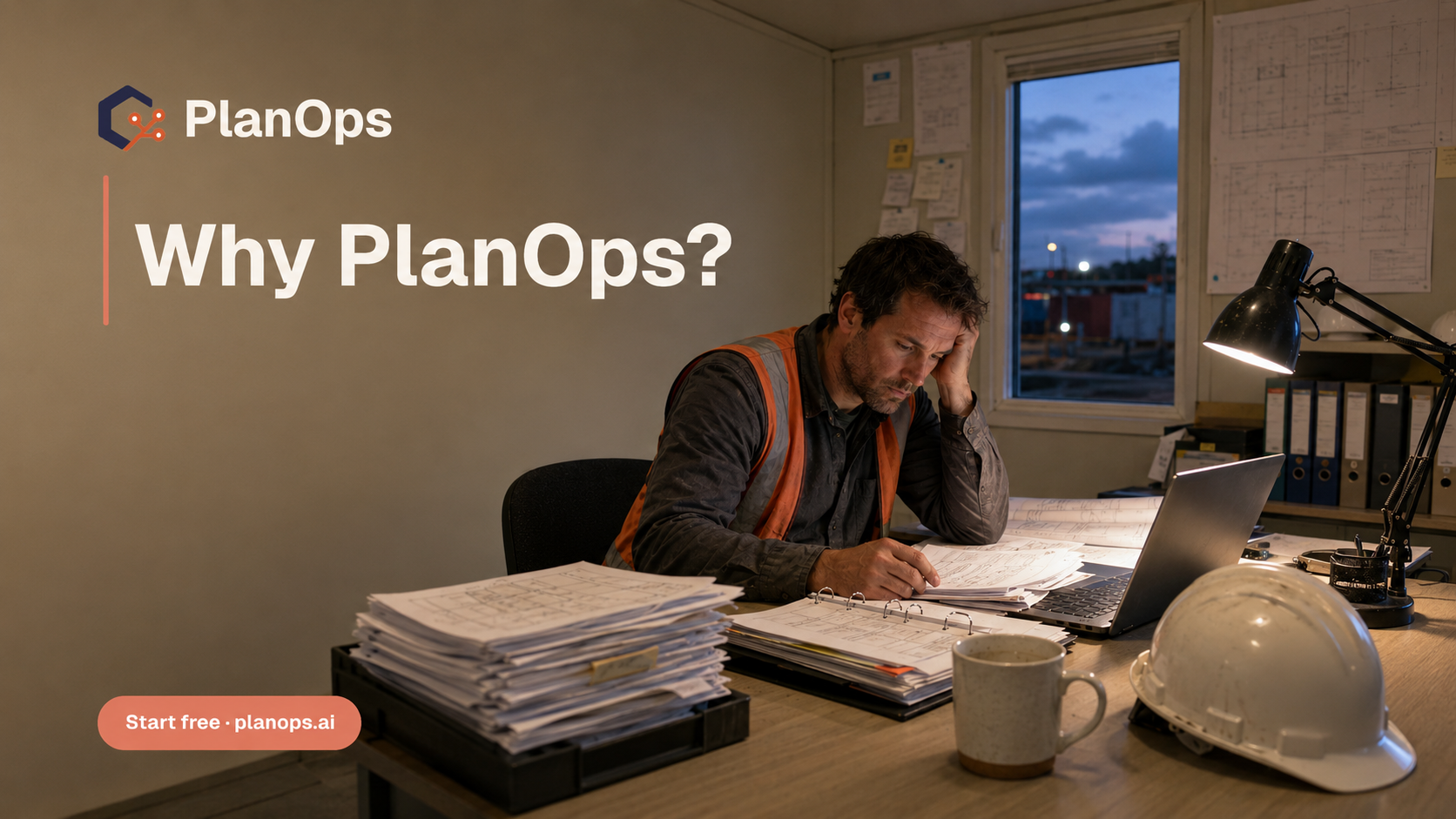
Ask any project manager where their week goes and you'll hear the same answer. Reports. Forms. Chasing and checking documents. The Construction Phase Health & Safety Plan that takes days. The progress report that eats an afternoon.
None of it is the actual job. It's the tax you pay to do the job.
We built PlanOps to bring that tax down.
The tax, named
Every project carries a load of work that produces no building. It produces paper. A weekly progress report has the same shape every week. A handover pack pulls from the same sources every time. A safety form asks the same questions it asked last month. A subcontractor's RAMS lands in your inbox and has to be read against requirements you already know by heart.
It's repetitive, structured, document-heavy work - exactly the kind of thing that should already be automated, and almost none of it is. So it falls to the most expensive, most experienced people on the project, and it falls to them in the evening, after the actual job is done.
That's the tax. Not the effort of running a site - the effort of proving, in writing, that you ran it.
The problem isn't effort
The people on UK sites aren't short of effort. They're short of hours. Most project management software answers that by adding another place to log in, another set of fields to fill, another dashboard to keep current. It assumes the bottleneck is information. It isn't. The bottleneck is the hours spent turning information into documents.
Start from your project, not a blank page
PlanOps does the opposite of adding work. You say what you need in plain language, and a structured, review-ready draft comes back - built from what your project already knows.

- A weekly progress report that starts from your project information instead of a blank page.
- A construction phase plan drafted from your pre-construction information.
- A weekly observations form created the moment you ask for it.
- A subcontractor's RAMS reviewed against your safety requirements.
A human eye, on a draft - not a blank page
None of this takes the judgement away. The work still needs a human eye, and it gets one. But there's a difference between reviewing a well-crafted draft and building one from nothing at nine o'clock at night. PlanOps does the typing and the assembly; you do the deciding. No training day, no menus to memorise, no waiting on a specialist - the PM keeps the call on what's right for the project, which is where their time was always worth most.
Built for the people who carry the project
PlanOps is built for UK contractors, around the way construction actually works - its documents, its forms, its language. That focus is deliberate. A general-purpose assistant can write you a poem; it can't produce a compliant handover pack. We'd rather do one industry properly than every industry vaguely.
The whole point
Give people their time back. On site, on the project, where it counts - not buried in a document that a machine could have drafted in the time it takes to read this.
That's the measure we care about: how many evenings did we hand back?
Start with one task you already do every week. It's free to begin - 50 credits (Intelligence Units) on real project work, no card needed. Start free and pick the job you'd usually dread.