Weekly Roundup
Week 14: The 36% vs the 31% - and the Infrastructure Gap in Between
UK construction AI crossed a threshold this week. Adoption is at 75%. But measured results belong to a third of the industry. Planning is the new bottleneck. And the tools are now accessible to firms of every size.
The Adoption Numbers Look Good. The Strategy Gap Doesn't.
The biggest number this week came from the Association for Project Management. Seventy-five per cent of construction project professionals now use AI. Two years ago it was 15%. That's not incremental. That's a category shift.
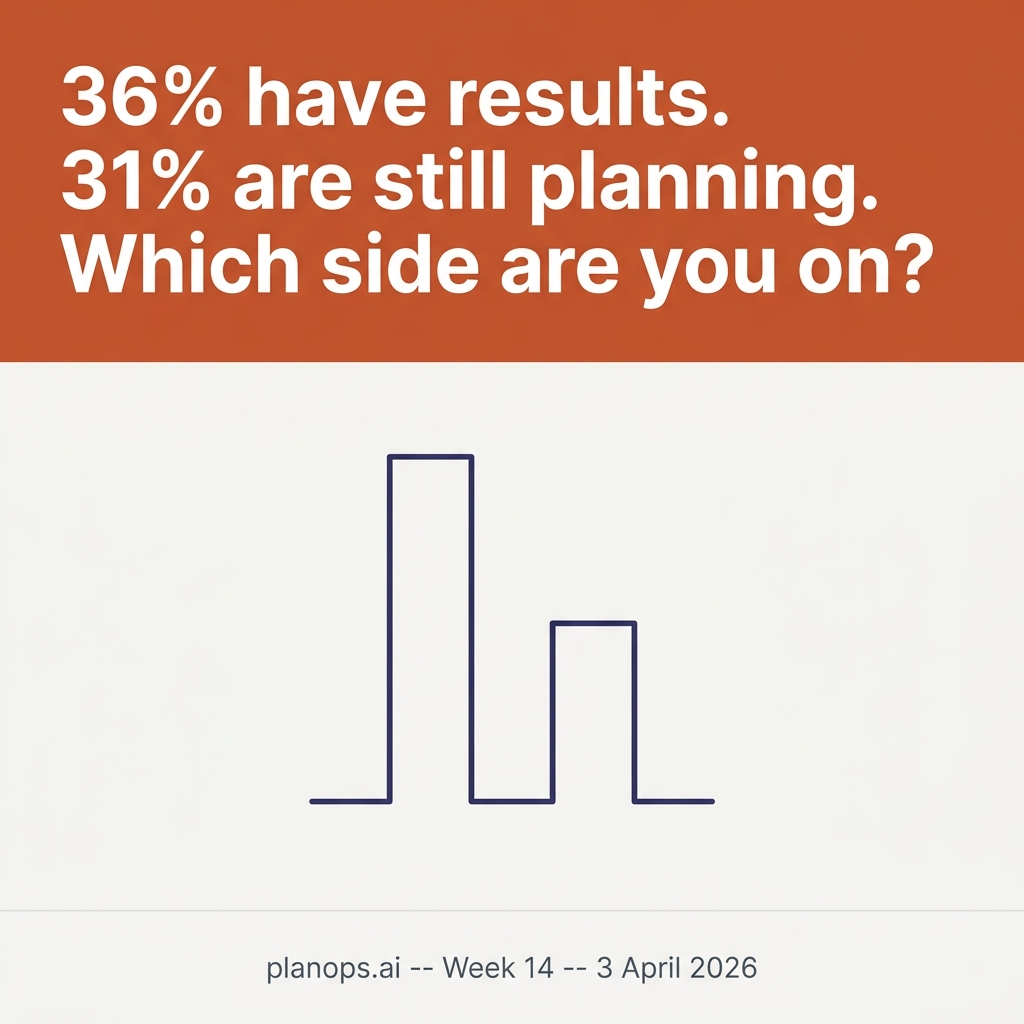
But here's the thing about adoption statistics. They measure who's using something. They don't measure how well, or to what end, or whether the results justify the investment. The same APM survey found that 36% of firms have a clear strategy delivering tangible benefits. Another 31% are still gathering proposals for pilot projects. Those two groups are both "using AI." They're having completely different experiences of it.
The CM Awards shortlist this week put numbers on what the first group looks like. Six firms, six real deployments, all with documented outcomes. Ninety per cent time savings on document classification at AtkinsRealis. Twenty-eight-plus hours saved per bid at Willmott Dixon. £474,700 in estimated annual cost avoidance at Taylor Woodrow. NavLive saving roughly £50,000 on a single survey project.
These aren't productivity experiments. They're commercial results. And the gap between the firms producing them and the 31% still in the pilot-gathering stage is growing every week.
Thursday's brief added an important qualifier. Bluebeam's research found only 11% of AEC firms describe themselves as fully digital across all project phases, even though 84% plan to increase technology investment this year. Archdesk's agentic AI analysis arrived at the same uncomfortable conclusion from a different angle: AI is only as good as the data feeding it. Firms with fragmented systems - estimating in one tool, scheduling in another, costs in a spreadsheet - will see limited benefit from AI investment regardless of which tools they buy.
The AI adoption story in UK construction right now is actually two stories. The first is the 36%: firms that have cleaned up their workflows, structured their data, and deployed AI in core commercial and compliance functions. They're compounding their advantage every quarter. The second is everyone else: using AI in some form, but not yet at the level where it changes outcomes.
The week also threw up a system-level problem. The UK government has a 6GW AI data centre target for 2030. The current trajectory gets to 4.9GW - and only if a wave of planning consents clears by 2027. Planning, not funding or technology, is the constraint. That's a construction and planning tech problem as much as it is a policy one. The firms that understand it are well placed.
There was also good news for smaller firms. Construction AI launched an AI-native project management platform built by a Chartered Builder with no software background - 700,000 lines of code, 60-plus AI tools, priced at £2,000 lifetime. And Re-flow's new PAS 2080 module embeds carbon compliance into the workflows infrastructure contractors already use. The tools are reaching firms of every size now. The barrier to entry has dropped.
The message from the week is consistent. Adoption has surged. Results belong to those with a strategy. The workflow and data foundation determines whether the tools work. And the infrastructure the UK needs to remain competitive depends on construction firms moving faster than the planning system currently allows.
The question isn't whether to invest in AI. It's which side of the strategy gap your firm is on.
Top Stories This Week
CM Awards Best Use of AI Shortlist: Six Firms, Six Real Results
The Construction Management Best Use of AI shortlist for 2026 (published 31 March) is the most practically useful document in UK construction AI right now. Not because of who's nominated - because of what they've documented.
BidLevel and ProcurePro cut quote-levelling time by 80%, roughly 60 seconds per tender package. Hoppa AI slashed document classification time by 90% at AtkinsRealis, processing a nuclear decommissioning project 100 times faster than manual workflows. Willmott Dixon's Claude-powered Knowledge Hub saves 28-plus hours per bid - a nine-question bid response drafted in under five minutes. NavLive saved approximately £50,000 on a single survey project versus traditional methods. Taylor Woodrow's Auto ITP system delivers £474,700 in estimated annual cost avoidance. Ramboll's District One reduced district energy network routing from weeks to hours.
None of these are pilots. All have numbers attached. The tools are in production, at named UK firms, delivering measurable commercial outcomes.
Why it matters
This shortlist is the benchmark. If your firm is still at the "we're exploring AI" stage, this is what you're being measured against. The results are real and they're in the market now.
Source: Construction Management - Best Use of AI 2026 Shortlist →
APM Survey: AI Use in UK Construction Jumps From 15% to 75% in Two Years
The Association for Project Management published survey data this week (Wednesday 1 April) showing 75% of construction project professionals now use AI in their work - up from 15% two years ago. Ninety-one per cent plan to increase AI investment in 2026.
But the headline hides a more uncomfortable story. Only 36% of firms have both a clear AI strategy and tangible results. Forty-two per cent identify legacy technology as the single biggest barrier to meaningful adoption. The adoption curve has steepened dramatically. The results gap is widening at the same time.
The FMB published a practical guide this week on five ways SME builders are using AI right now - covering estimating, H&S documentation, tender preparation, site communications, and customer queries. Worth reading if you're a smaller firm and want a grounded starting point rather than a tier-one contractor case study.
Why it matters
Seventy-five per cent adoption means AI in construction has crossed from early-adopter to mainstream. The question for your firm isn't whether to adopt AI anymore. It's whether you're in the 36% that have a strategy and results - or the 64% that don't yet.
Source: FMB - 5 Simple Ways Builders Are Using AI Right Now →
The Planning System Is the Bottleneck - and £ Billions Depend on It
Two separate threads this week converged on the same conclusion: planning consent is now the primary constraint on UK AI infrastructure delivery.
A Computer Weekly analysis (2 April) found that even with the approved data centre pipeline, the UK is on track for 4.9GW of AI-capable capacity by 2030 - not the 6GW Secretary of State Peter Kyle committed to. The unapproved pipeline totals 8.1GW, meaning 6GW is theoretically achievable. But it requires a wave of planning applications to clear by 2027. That's a tight window. Many existing facilities are too old to upgrade to AI-capable standards without essentially rebuilding them.
A Travers Smith legal update from the same week confirmed government guidance now requires designated AI infrastructure sites to demonstrate planning consent - or a credible pathway to it - by 2028, with a minimum capacity of 500MW per site.
Also on the policy front: Parliament's House of Commons Library updated its data centre planning guidance (30 March), requiring local authorities in England to factor AI infrastructure demand into local plans. For the first time, planning policy explicitly acknowledges AI compute as infrastructure to be planned for, not an afterthought.
Why it matters
Planning reform and planning tech aren't abstract policy debates. They're the primary bottleneck on a multi-billion-pound UK construction pipeline. Firms with data centre construction expertise, planning support capability, or highways and civil engineering experience are looking at a growing and well-funded opportunity.
Fix the Workflow First. Then Add the AI.
Bluebeam's Steve Smith wrote one of the most direct pieces on UK construction AI this week. The headline findings from Bluebeam's own research: 84% of AEC firms plan to increase technology investment in 2026, yet only 11% describe themselves as fully digital across all project phases.
The argument is uncomfortable for a lot of firms. AI can't rescue a workflow built on broken processes. The Get it Right Initiative puts the cost of avoidable errors in UK construction at somewhere between £10bn and £25bn per year. The root causes are familiar: poor information flow between site and office, inconsistent naming conventions, mixed paper-and-digital handovers. These aren't technology problems. They're behaviour and process problems.
Archdesk's agentic AI analysis this week arrived at the same conclusion from a different angle. Firms with fragmented systems - estimating in one tool, scheduling in another, costs in a spreadsheet - will see limited benefit from AI regardless of what tools they buy. Data unification isn't a nice-to-have. It's the prerequisite.
Why it matters
Before signing off on another round of AI investment, audit the basics. How does information move from site to office? Are naming conventions consistent? Where are the paper-to-digital gaps? The firms in the 11% who are genuinely digital are using AI as an accelerant. The rest are still diagnosing the problem AI is supposed to solve.
CN Awards 2026 Shortlist - AI Tools Are Now Competing on the Main Stage
The 30th CN Awards shortlist (published 2 April) carries a useful signal about where the industry has landed. The innovation category shortlists AI-native tools alongside the industry's largest contractors - Alice Technologies (AI scheduling), MSite (workforce management), and Hyperion Robotics (3D printing and construction robotics) are all nominated, alongside AtkinsRealis, WSP, and major contractors including Kier, Balfour Beatty, Willmott Dixon, and Costain.
This isn't a fringe innovation event. CN Awards is the industry's main stage. Alice Technologies and MSite being shortlisted here means AI scheduling and AI-driven workforce management are now considered valid entries in the same room as major infrastructure projects. Hyperion Robotics also made a commercial UK launch this week alongside the nomination - their founder described it plainly: construction robotics has moved from pilots and prototypes to commercial-scale deployments.
Why it matters
If you want a quick read on what the industry considers mainstream AI in construction right now, this shortlist is the list. It's a reasonable benchmark for where the leading edge sits in April 2026.
Source: Construction News - CN Awards 2026 Shortlist Announced →
Stop chasing updates. Let PlanOps handle the planning paperwork.
Also Worth Noting
EU AI Act Compliance Clock: Four Months to the August Deadline (Wednesday 1 April)
The EU AI Act's general obligations take effect on 2 August 2026. UK construction firms with EU exposure using AI for safety-critical applications, worker monitoring, or automated decision-making need to assess compliance now. Legal analysis from Browne Jacobson is direct: standard construction contracts haven't yet adapted to AI deployment, creating liability gaps for firms that haven't audited their tools. The anticipated UK AI Bill has been delayed to mid-2026, leaving a regulatory gap.
If your firm uses AI for risk assessment on higher-risk buildings, site monitoring, or automated contractor scoring, a legal review before August is prudent - not optional.
Source: Browne Jacobson - AI and Emerging Legal Challenges in Construction 2026 →
Re-flow Launches PAS 2080 Carbon Data Module (Friday 3 April)
Re-flow released a module that builds PAS 2080 carbon reporting into the workflows infrastructure and highways contractors already use. Every shift, quote, delivery, and form produces structured, GPS-timestamped carbon data automatically. No separate manual data collection. That's the direction all compliance reporting is heading - embed it in normal operations rather than ask site teams to do extra work at the end of a job.
Construction AI Launches AI-Native Platform for UK SMEs (Thursday 2 April)
Construction AI went live - a project management platform built by Steve McKenna (Chartered Builder, MCIOB, 30 years' experience, no software background) using AI tools. Over 700,000 lines of code, 60-plus AI-powered tools covering RAMS generation, construction programmes, OCR-powered drawing management, and tender analysis. Introductory pricing at £2,000 lifetime for two seats. The practical takeaway: the barrier between deep domain knowledge and production-quality AI tooling has effectively collapsed.
Source: GlobeNewswire - Construction AI Launches First AI-Native Platform for UK SMEs →
What matters most
- →The adoption numbers are no longer in question. Seventy-five per cent is a mainstream story. The question is whether your firm is in the 36% with a strategy and results - or the 31% still gathering pilot proposals.
- →The CM Awards shortlist is the best single document showing what AI ROI looks like in UK construction right now. Read it and benchmark your firm against it.
- →Planning is the bottleneck. The UK needs its unapproved data centre pipeline to move through consent by 2027 - that's a construction and planning tech problem, not just a policy one.