Construction AI Brief
Construction AI: two thirds now use it, one in five relies on it, and the money last week backed the wires not the paperwork
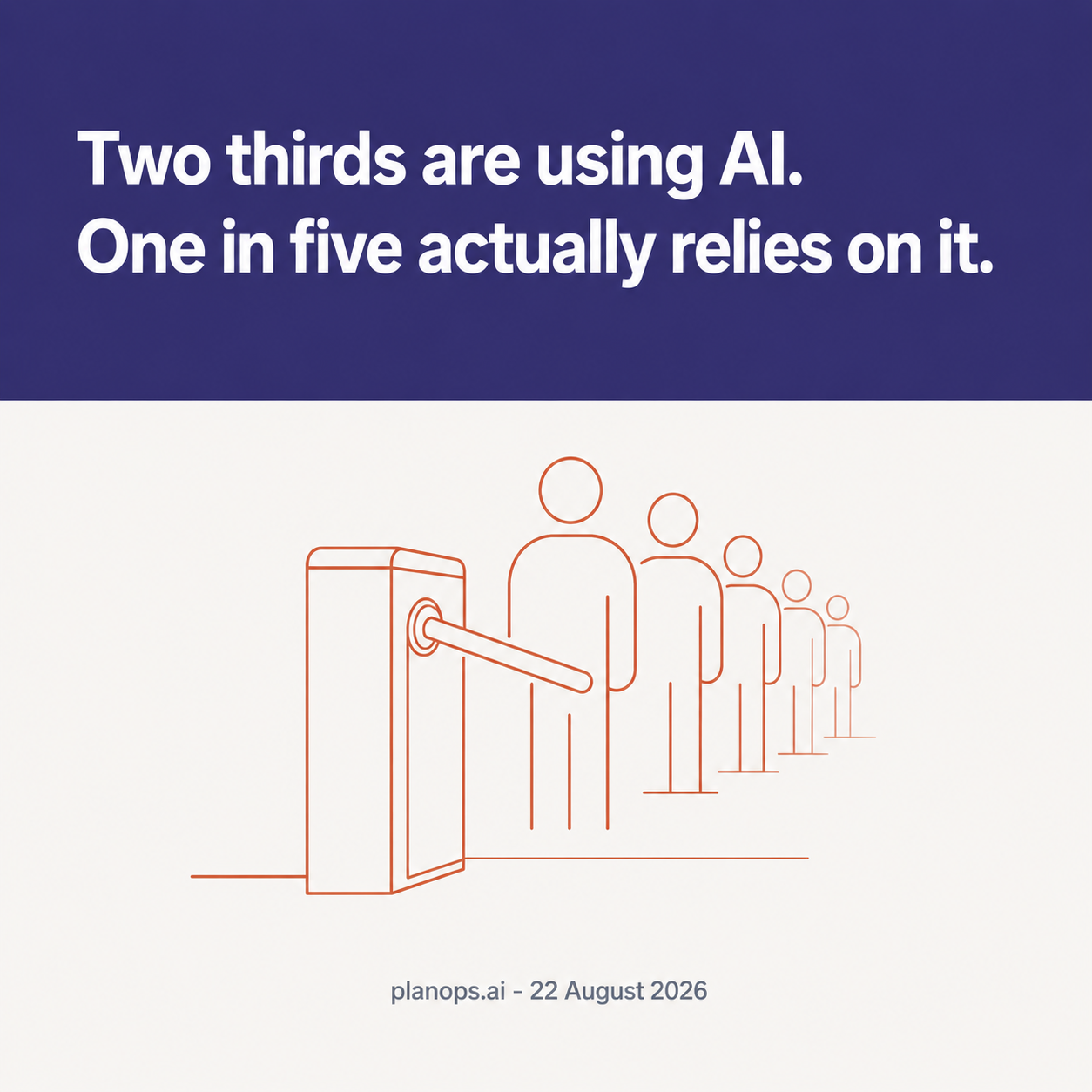
RICS published its 2026 AI survey on 18 August: two thirds of construction professionals now use AI in some form, but only 19 per cent use it regularly, and the barrier that grew fastest was security. On the same week the contech cheques went to spatial data and to the transformer shortage stalling data centres, not to the office admin most contractors think AI is for.
AI-assistedPrepared with AI assistance and human editorial review.
Today’s context: This brief covers the latest movements in AI tooling, adoption, and signals for construction teams. Read on for what matters and what to focus on.
Industry Readiness - Featured
Two thirds of construction now uses AI. One in five actually relies on it.
RICS published its AI in Commercial Property and Construction Report 2026 on 18 August, and it's the fullest read on where the UK sector actually is, built on more than 3,100 responses rather than a vendor's customer list. The headline is genuinely good news. Two thirds of construction professionals now use AI in some form, up from just over half in 2025. Among commercial property people it's more than three quarters. The tool has gone from novelty to normal in about two years, which by our sector's usual pace is fast.
But read the second line and the mood changes. Regular use, the sort where a tool has earned a place in someone's week, sits at just 19 per cent in construction. In commercial property it's 29. Both sectors have the same share, 39 per cent, still stuck in early pilots. So the gap isn't whether people are trying AI. It's whether the trial ever turns into a routine. Property is turning pilots into habits at half again the rate construction manages, on the same tools. What that means on a live job is a lot of teams with a licence and a demo and not much that's actually changed how the work gets done.
The reason is the interesting part, and it isn't cost. The barrier that grew fastest in construction was trust: respondents naming privacy and security concerns rose from 22 per cent to 30 per cent in a single year, alongside the familiar shortage of skilled people. I'd argue that rising number is a sign of maturity, not fear. A year ago people were playing with a chatbot. Now they're being asked to put a building's compliance record through one, and they've started asking the right question, which is where does my data go and who can see it. RICS points members at its Responsible Use of AI in Surveying Practice standard, in force since March 2026, which is the sober scaffolding this needs. For the person deciding whether to roll a tool out past the pilot, that's the filter: not is it clever, but can I say, in writing, where the client's golden thread ends up.
The procurement filter: Before any AI tool goes past the pilot on your patch, get a plain answer to one question in writing, where does our project data sit and who can read it. If the vendor won't put it on paper, that's your answer.
Tools & Platforms
Last week's cheques went to spatial data and the transformer bottleneck, not the paperwork
While the RICS numbers say contractors are stuck in the pilot pen, the money going into construction tech tells you what the investors think the real constraint is. The week to 17 August saw roughly $160m raised across eight startups, by the Bricks & Bytes count, and the two worth your attention both sit at the physical end of the job, not the office end.
The bigger one is NavVis, out of Munich, which pulled an $85m Series D to build what it calls a spatial data foundation for physical AI. Strip the phrasing and it's reality capture, the scan of a site or a plant turned into a live digital record that a robot or an agent can actually act on. Founded back in 2013, so no overnight story, and it says more than a billion square metres of plants, sites and buildings went onto its platform in 2025 alone (company figure, worth holding loosely). What that money is really backing is the layer underneath the clever stuff. Before an agent can check your site, something has to have measured it accurately, and that's the boring, capital-hungry bit people forget.
The one I'd actually watch is smaller. Fluxco, an Austin outfit founded only in 2025 by Brian Tochman, raised a $26m seed led by 8VC and Congruent to go after the electrical transformer shortage that's quietly stalling data centre construction. What it does is read a utility's transformer specification, match it against bids from more than 150 global OEMs in days rather than months, then handle the leasing and the logistics. Unglamorous. Also exactly the sort of thing that decides whether a data centre opens on time. We keep talking about the data centre boom as a story about chips and power. Down at ground level the chokepoint is often a grey steel box with an eighteen-month lead time, and now there's an AI tool pointed straight at it. That's a more honest picture of where AI earns its keep in construction than any office-admin demo.
Worth watching: If your pipeline touches data centres or grid work, the long-lead electrical kit is the risk that no software fixes, only surfaces earlier. Get your transformer and switchgear orders named and dated in the programme now, not at the six-month mark.
Adoption & Evidence
The question this year is governance, not whether to bother
Put the two stories side by side and they point the same way. The RICS survey says the thing holding construction back has stopped being doubt about whether AI is useful, and become a fair worry about trust, skills and where the data goes. The money going in agrees the hard part is physical: the spatial record underneath, the electrical kit that carries the load. Neither story is about whether to use AI. Both are about the plumbing you need in place before it's safe and useful.
So the discipline stays what it's been all summer. When a tool reads your drawings and writes your registers, the two questions that decide whether it's safe are what it was taught and what it can touch. The RICS numbers just put a figure on how many of your peers have started asking. The ones who move past the pilot this year won't be the ones with the cleverest tool. They'll be the ones who can answer those two questions and get on with it, while everyone else runs another trial.
For your board pack: List every AI tool your teams have trialled this year, and mark which ones moved from pilot to routine. The blank rows are your real adoption problem, and the reason is almost always trust or skills, both of which are yours to sort.
Source: AI adoption rises in construction and commercial property (Mortgage Introducer) →
What matters most
- →"Adoption isn't your problem any more; getting past the pilot is. Pick one AI task your team runs every week without thinking about it, and ask why the other five you trialled never got there. The answer is usually trust or skills, and both are yours to fix."
- →"The security concern that grew fastest in the RICS numbers is a rational one, not a Luddite one. If a client's golden thread is going into a tool, knowing where that data sits and who can read it is due diligence, so treat it as a procurement question and get it in writing."
- →"If you've data centre work on the books, the binding constraint is drifting from planning to power to the kit that carries the power. A transformer with an eighteen-month lead time can move a handover more than any software will, so chase the long-lead items now."
Ready to put AI to work on your projects?
50 free Intelligence Units. Set up your first project in under 20 minutes. No credit card needed.
Get 50 free Intelligence UnitsGet the brief by email
Daily practical AI insight for construction teams. What changed, why it matters, and what to ignore.
50 free Intelligence Units - automate your programme admin
Why PlanOps publishes this
We help construction teams turn AI into useful work, not noise. Understanding what’s changing in AI is the first step. Making it work on-site is the real difference.
Related issues
data-centresgovernment-policy
Construction AI: west London says yes to another 64MW shed, and Ofgem starts pricing the queue
Hounslow waved through a data centre near Heathrow on 6 August, and within days Ofgem was consulting on a commitment fee of up to £712,500 a megawatt to clear the speculative jobs out of the grid queue. On the tools, a Nashville startup put cameras on the frontline that watch the work and the worker, and the layer every construction agent now rides on quietly got a security beta. The pipeline is real. The grid is the wall.
- • "Hounslow Council approved the Haslemere Heathrow Estate data centre on 6 August 2026: three buildings up to 50,000 sqm, 64MW of demand for 48MW of IT load at a targeted PUE of 1.35, on a 12.2-acre brownfield site, brought forward by Brixton (Heathrow Estate) Ltd, tied to California's Kennedy Wilson."
- • "Ofgem is consulting on a Data Centre Commitment Fee of £237,500 to £712,500 per megawatt, payable when you accept a connection offer, refunded once you connect and forfeited if you leave the queue early, plus data-centre-specific milestones you have to keep evidencing; the consultation runs to 16 September 2026."
Found this useful? Share it.